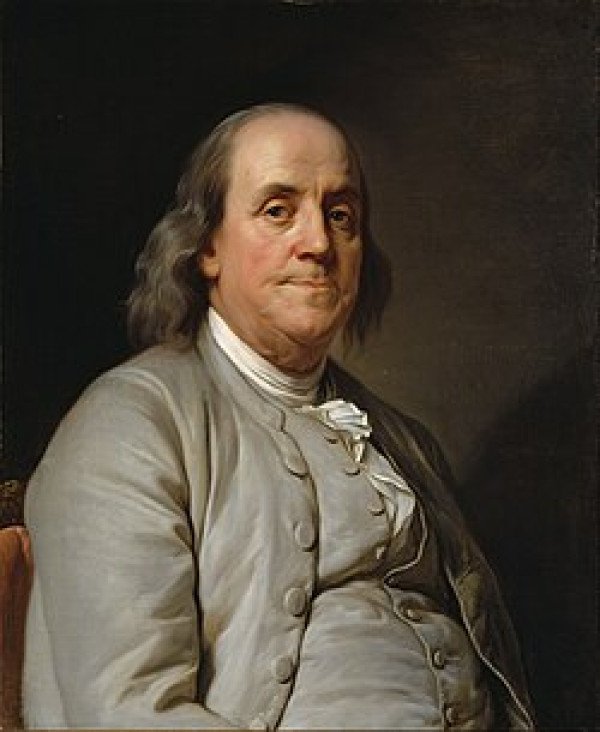
 Benjamin Franklin (1706–1790) was a pivotal American polymath, diplomat, and Founding Father who helped draft and signed the Declaration of Independence. As part of the Committee of Five, he edited Jefferson’s draft, notably changing "sacred and undeniable" truths to "self-evident," grounding the document in reason rather than religion.
Biography
- Early Life & Printing: Born in Boston, he was a printer by trade, eventually building a successful publishing business in Philadelphia, including the Pennsylvania Gazette and Poor Richard's Almanack.
- Scientist & Inventor: Franklin gained international fame for his experiments with electricity and invented the lightning rod, bifocals, and the Franklin stove.
- Diplomat & Statesman: He spent years in London trying to avert the Revolution before helping draft the Declaration (1776). He then secured the critical French alliance and signed the 1783 Treaty of Paris.
- Final Years: He served as a delegate to the 1787 Constitutional Convention, supporting the new U.S. Constitution.
Contribution to the Declaration of Independence
- Committee of Five: Franklin was appointed alongside Thomas Jefferson, John Adams, Roger Sherman, and Robert Livingston to draft the document.
- Editor: While Jefferson was the primary author, Franklin made crucial edits to the draft.
- "Self-Evident" Truths: Franklin is credited with changing Jefferson's phrase "sacred and undeniable" to "self-evident," a shift that emphasized enlightenment rationalism over religious dogma.
- Signer: He signed the final document, representing Pennsylvania.
Franklin's reputation as a wit and wise statesman made him an essential figure in guiding the young nation during its most critical moments.
Connections to Scotland and Ayrshire
- University of St Andrews (1759): The University of St Andrews awarded Franklin an honorary Doctor of Laws degree in 1759 in recognition of his work on electricity.
- Freedom of the Burgh: He was granted the freedom of the city of St Andrews, traveling to Fife to receive the honour in person.
- Academic and Personal Friendships: He toured Scotland, meeting with prominent Scottish Enlightenment figures like philosopher David Hume and economist Adam Smith.
- Affection for Scotland: Franklin expressed profound admiration for Scotland, stating, "I believe Scotland would be the country I should choose to spend the remainder of my days in," had he not had other commitments.
- Glasgow Visit: He visited the University of Glasgow, spending time with academic John Anderson.
Franklin, while closely associated with his native Boston and Philadelphia, developed a deep affection for Scotland during his time in Britain before the Revolution