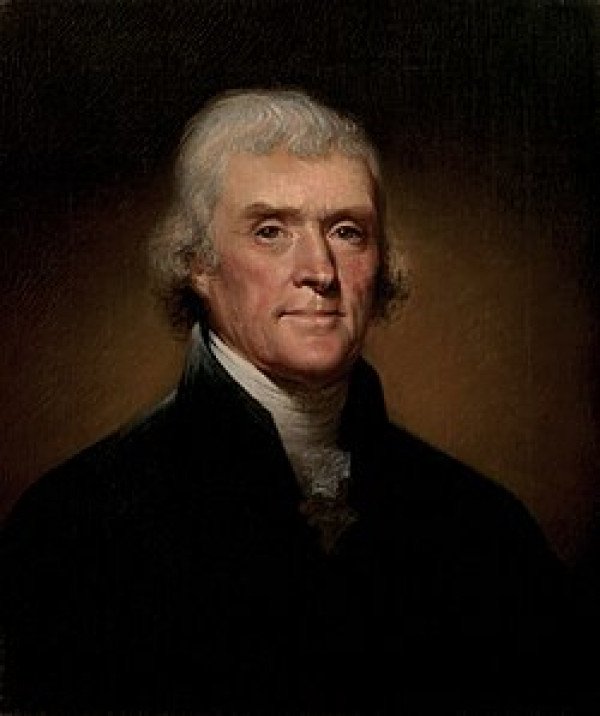
 Thomas Jefferson was the primary author of the American Declaration of Independence, tasked by the Continental Congress to draft the document between June 11 and June 28, 1776. He articulated the young nation's core principles of natural rights, including "life, liberty, and the pursuit of happiness," justifying the separation from Great Britain.
Key Contributions to the Declaration:
- Primary Author: As the youngest member of the "Committee of Five" appointed by Congress, Jefferson was chosen to draft the document due to his reputation as a graceful writer.
- Drafting the Document: Jefferson largely worked alone, creating a draft that justified independence, laid out 27 specific grievances against King George III, and asserted the right of revolution.
- Philosophical Foundation: He articulated that "all men are created equal" and that governments derive their power from the "consent of the governed".
- Revision Process: While his original draft was largely kept intact by Benjamin Franklin and John Adams, they and Congress heavily edited it. Notably, they removed a clause that directly criticized the King for the transatlantic slave trade.
The final document was approved on July 4, 1776, formalizing the transition from rebellion to a war for independence.
Legacy of Jefferson's Work:
- Ideological Document: The declaration transformed the war from a protest against taxes into a revolutionary fight for universal human rights.
- International Impact: The document influenced democratic movements worldwide, including the French Revolution.
The original, heavily edited, and final documents are central to American history, with the final parchment now residing in the National Archives in Washington.
Connections to Scotland and Ayrshire
- Scottish Tutor and Mentor: Jefferson considered his Scottish tutor, William Small, a professor at the College of William and Mary, to be his greatest influence. Small, born near Arbroath, introduced Jefferson to Enlightenment thinking.
- Maternal Scottish Heritage: Jefferson’s mother, Jane Randolph, was of Scottish descent. Records suggest she descended from the "powerful Scotch Earls of Murray" and that Jefferson was a distant relative of Robert the Bruce, both sharing descent from Malcolm III of Scotland.
- Intellectual Scottish Ties: Jefferson was deeply influenced by Scottish moral philosophers. He also corresponded with and respected figures from the Scottish Enlightenment, which he studied during his formative years.
- The Declaration of Arbroath: Some scholars suggest the 1320 Scottish Declaration of Arbroath, which influenced many Scots and Scottish-Americans in the Continental Congress, served as a template for the American Declaration of Independence.
Although Jefferson himself expressed that his ancestor came from Wales, he acknowledged that his mother's family, the Randolphs, traced their pedigree back to England and Scotland.